Friday, 10 July 2015

And so it begins.


And so it begins.


This morning I lovingly taped together my well-loved, battered copy of All Quiet on the Western Front.  This is the very same copy of the book which started me on this journey in the first place.  It is the copy I borrowed from a school 22 years ago.  I was looking for an interesting read at the time. 
Last summer I described the impact of this book on my life and it was last summer when I began to meditate upon the anniversary of the beginning of the Great War.  I wrote poetry about the Vimy Monument and mused about the pull of our ancestors from the dusty past.  I dreamed of columns of men marching out of the fog toward the killing fields of France.  I dreamed of standing on that holy ground, shedding tears for the dead sons of mothers who would never see their boys again as they remembered them: alive, happy, or whole.

In one week, I will be in Paris. 

One week tomorrow, I will be on my way to Arras.  


And in many ways I just cannot believe it is happening.  In a week I will be standing on sacred ground.  I will be running my hands through the soil enriched by the blood of men who never, truly understood the horrors they would have to endure.  I will be living a dream I have had for over 22 years.  A miracle, really.

I have decided to make this a blog post because a friend and fellow student of the Great War asked me to blog my trip.  I thought I would start now because I want to capture all of it: before, during, and after.

Honestly, part of me is afraid that I have hyped this trip so much for myself that I have set myself up for disappointment.  The other part of me tells myself not to be such a downer and to just relax into the experience.  What if they, the spirits, decide not to talk to me or to not reach out?  I do not have any ancestors in those fields that I can confirm for sure so I am reaching out to the souls of others.  I know I have ancestors on both sides who fought and died but they are untraceable to me because my paternal great-grandfather changed his last name to make it easier for the bureaucrats to spell when he arrived in Canada. 

I can’t find my Prussian dead.  I don’t know their names. 

So what I’ve done is I’ve chosen some names.  Names that could have been my mother’s mother’s family.  Names from my childhood – an “invisible friend” named Arthur who had to sit at the table with us at meal times…who disappeared after my sister was born. 
I’ve chosen some names from my father-in-law’s book of names of the Great War dead, complete with a description of where they are buried so I know where to look.  I have found an Arthur Rutherford…who knows…maybe he’s related to me through my Granny, Eva Rutherford.  I will look for him.  Who knows, maybe he is my war dead.

This trip feels so heavy already.  I think mostly out of sheer gratitude to the universe, and my husband and daughter, for their encouragement and help to make it possible.  I never actually thought I would ever get to make this trip.  The weight of this realisation overwhelms me.

But I am grateful.

And anxious.

And excited.

I am preparing for whatever comes, or doesn’t, during this trip – this pilgrimage to this soul-soaked land; this land watered with tears and blood.

Now that my battered copy of All Quiet… is patched up, I am ready.  Paul and I and the boys will wander the fields of France and I will know that I am not alone.

 
Ghosts.  The Vimy Memorial

Sunday, 24 May 2015

Just Another Torn Paige


https://www.rcybc.ca/paige

(Link to the report)

The name Paige was in the forefront of people’s minds for a couple of days.  For a couple of days, before the provincial government diverted attention away from their gross neglect and onto LNG agreements, her name blasted from our radios and televisions for no other reason than she is dead. 

Another dead Aboriginal woman.

Another dead Aboriginal woman whose life could have been saved.  The opportunities were there for others to step in and protect her.  Those opportunities presented themselves several times through several years of her life.  Over and over government agencies had the opportunity to step in.  They did not.  They failed.

We failed.

We failed and yet another indigenous child died in care.

In last Friday’s report from the Representative for Children and Youth (an independent body acting as an advocate for children and youth in care in British Columbia), Mary-Ellen Turpel-Lafond pointed out every hole torn in the safety net that was supposed to catch Paige and many other children like her.  In her report, Turpel-Lafond:  exposed the “systemic indifference” of MCFD social workers and other members of the child and youth services teams; casts light into the shadow of the child and youth welfare system in this province; calls out the blatant institutional gaps which can only be described as racist;  and exposes the complete lack of imagination of MCFD, the Ministry of Education, specifically,  and the provincial government in general, when it comes to creating systems and practices that work to serve those who need it the most.  She exposes practices which seem to utterly lack compassion, curiousity, and competence when to not possess such traits costs lives.  
Through her interviews with a number of members of MCFD and different school personnel, all along the continuum of care, we see the need for increased resources for youth in terms of mental health and addiction supports, as well as supports for those people living in intergenerational trauma.  We see how schools let her slip away and how medical and police professionals had ample opportunities to support her but never did.   We see how each member of the “team,” the community let her down and, in effect, let her die.


MCFD

MCFD has been identified by Turpel-Lafond as the biggest hole in the net.  She says that specific policies and practices, as well as a blatant failure to act in situations where Paige needed to be protected from abuse and neglect (starting as early as when she was five months old), resulted in Paige’s death.  Turpel-Lafond feels that there is strong legislation and policy in place to prevent the deaths of aboriginal children (especially girls) but that “…there is too often a distinct lack of follow-through by professionals.” (p. 8)

The Representative lists the numerous times that members of the community (school, workers in hotels in the DTES [Downtown East Side]) made reports to MCFD that Paige was neglected and even had markings or indicators of abuse.  In several cases social workers did nothing.  In other cases, child protection reports were misfiled, filled out incorrectly, or not recorded at all.  Time after time social workers did not follow through on meetings with Paige, put the onus on Paige to contact them, and even left a false paper trail stating that Paige was receiving service she was not receiving.  On paper, Paige was seeing counsellors.  In reality, she saw no one.

Three factors leading to Paige’s death, as identified by Turpel-Lafond, really disturb me are:
1.        Outreach work for youth at risk and living on the DTES has been out sourced to third party service providers.  These providers are not bound to the provincial legislation regarding child protection as found in the Child, Family, and Community Services Act.  These service providers work outside of the provincial laws regarding child protection and, as such, are not obligated to report any situations which would break child protection laws.  In addition, these service providers were also not obligated to report to MCFD in any formal reporting out.
WHAT?!!!! 
MCFD contracts out to people who are “above the law” when it comes to reporting on child protection cases.  That’s right.  They are not obligated to act and they are not obligated to report.  Nice use of resources.

2.        The process of “aging out” for foster children has changed over the years but the expectation that a young person, at the age of 19, will be stable enough to care for themselves, and, thus be ceremoniously “booted out” of foster care is absolutely ludicrous.  Particularly if the child in question has a history laden with trauma, as Paige did.

I have had the honour of being asked to participate in Youth Transition Conferences with a number of youth in my career and see the extremely valuable place these conferences play in the lives of youth – particularly aboriginal youth.  During these conferences, the youth chooses people who have had an important role in their lives to sit and share how they are going to continue to support the youth into adulthood.   It’s like being invited to spend the rest of your life with this youth as a part of it.  You are, in effect, being chosen to be a permanent member of the kid’s family…for life.  This was an amazingly powerful experience for all of us:  the youth was reassured that he was not going to be left high and dry in his life when things got bad or, conversely that there would be people around to celebrate the good times; the adults felt greater levels of efficacy in their work with the youth; and the whole lot of us felt connected to a greater purpose than we had as individuals.  The conference was a testament to the attachments the young man had made in his first 19 years.  The conference assured the young man that he had people to watch out for him and places he could go in emergency situations. 

The Youth Transition conference is great if and only if the youth has significant attachments established in his/her life. 

From my observations, it seemed to me that Paige did not have many, if any, healthy, positive, significant attachments to anyone in her life that would have made a “proper” Youth Transition Conference possible.  Paige did not have the stability or connections to place or people that the young man in my above example had.  In fact, when Paige turned 19, in the face of objections and concerns by her foster parents at the time of her “aging out,” she was forced out of her foster placement.  Paige’s foster mother repeatedly stated her concerns to Paige’s social worker who, by the way, had no knowledge or understanding of Paige’s story, her history of neglect, and her trauma.  The only thing her social worker knew was that Paige was struggling with alcohol and drug use.  So, the day after Paige’s 19th birthday, Paige’s foster parents were instructed to pack all of her belongings into garbage bags and to deliver them to the school Paige was attending because she was officially on her own.  In fact, after Paige found a place and moved into her new living situation, her social worker did not check in with her to see if the placement was safe or appropriate because “…the move happened the day after her 19th birthday, when he was no longer responsible for her file.” (p.64)

So, check this out:  Paige’s foster parents, the first people she actually felt an attachment to according to Paige herself, begged the ministry to let Paige stay with them so she could get the mental health and addiction supports in place and were told that the MCFD mandate was to get Paige on her own and stabilized.  This young woman was, for the first time in many years, in a place where she was (a) with people she trusted a little (b) felt safe (c) open and amenable to addiction supports and she was KICKED OUT OF HER PLACEMENT BY MCFD BECAUSE OF A MANDATE TO AGE KIDS OUT AT 19!!!!!  And, to add insult to injury, Paige's substance use escalated to crack and meth TWO months after "aging out."

3.        Institutionalized Racism as demonstrated in the resistance of MCFD to address problems and mindsets around dealing with indigenous youth and families.

In my life I deal with many youth who are resistant to change and risk.  This does feel counter-intuitive when you witness the lives of risk many youth experience.  What I mean is that many youth, particularly those who have lived in inter-generational poverty or trauma, feel hopeless; that change is not possible and their lives are never going to get any better.  Especially youth who have no escape from abuse, neglect, and addiction in their homes.  Many youth in care have experienced this.  Many aboriginal children have experienced this.  Our mindset, or perception about those kids, their lives, and their ancestry profoundly impact the chances of their lives becoming any better.  How?  Let me tell you:  1. current service providers come to their practice from a disease based or pathology perspective.  You see the issues in the lives of the person and you try to remediate or remove the issue so that the quality of the person’s life will be improved.  2.  The same service providers work from the place of pathology when working with aboriginal youth and families.  They have the mindset that the trauma, addiction, and abuse issues are culturally ingrained and shackle the individual to their fate:  the cycle of more of the same.  While this is the reality of many indigenous people, it is not the only reality.  This variance in experience must be the place from which professionals seek to work with all people.  To practice from any other place would be to allow stereotypes to inform your work.

While, on the surface the disease model may seem an appropriate way in which to work with people who have complex needs (like homelessness, mental health challenges, addictions, etc.) it is, in fact deadly.  This approach teaches people that they are hopeless and that only outside forces will help them get better.   What is needed for people who have the above complex needs is, in fact the opposite approach.  In fact, many “best practice” recommendations around service planning for people who have needs similar to or mirrored by those on the DTES, is a practice grounded in the “strength based,” client-centered model.  

At the heart of this approach to care is the idea that the person has with in them the power and ability to make any changes they need to make their lives better and they know what they need.  The job of the social worker, teacher, counselor, would then be to play to the person’s strengths, to listen to the person's needs,  and be their biggest cheerleader when things go well, and their strongest supporter, without judgement, when things don’t.  Support people build relationships – authentic relationships built on respect, compassion, and honour for the other person’s story.  The relationships have to be real, not mandated.  In this way, people learn that there are trust worthy individuals in the world who actually care about them because of who they are, not because they are a number on a file folder. 

Compassion breeds hope.  Hope breeds change.  People ready themselves for change when they know someone will be there to cheer them on or to lift them up.
Image result for hope
How, exactly were service providers supposed to get Paige to believe that people really had her best interest at heart when the rug was continually pulled out from under her?  How was Paige supposed to believe her life had hope or purpose or meaning when she would just get her footing with people and she was yanked away from them again and again?  This was a reoccurring theme in Paige’s life from her birth.  She had no sense of permanence.  No sense of place.  No sense of community.

What many service providers do not realise is that you cannot engage people in change processes if they feel like there is no hope for change.  People have to believe that change is possible.  They have to have had experiences in their lives which demonstrate to them that they have power and control in their lives and when they “go out on a limb” and take the risk to change something in their lives, they need to feel that the change will actually happen.  The issue for Paige, and her mother, and her grandmother, was not that these women were actually “service-resistant” (p.62) but that their attempts to change resulted in a lack of effect that allowed them to feel hopeful about change.   Nothing ever seemed to get better for them, so why should they believe that things were ever going to change?   Paige’s grandmother died of an overdose, her mother died of an overdose 2 months after Paige herself died of an overdose.  If that was your reality, your whole reality for your whole life, how much would you believe others who told you your life could change?  How hopeful would you feel about change in your life?  Resiliency and efficacy come from loving attachments.  Trauma is only healed through loving relationships – the ability to trust that people are not going to hurt you.  You cannot process trauma if you do not trust people.  Paige had few attachments or loving relationships.  There were opportunities for them but they were ripped away.

MINISTRY OF EDUCATION AND SCHOOLS


This is my jam.  This is my area of expertise.  This is where I live:  highly at risk youth. 

Youth with addictions. 

Youth with attendance issues.

Youth in care. 

These kids are my people.

These kids are my people and I can very confidently say that I have, really, only been able to help a handful of kids.  Especially in the last few years with the Liberal government in power.  The cuts to schools and to services for youth have crippled us. 
I am unable to do my job with any confidence or effect because services for youth are A COMPLETE FUCKING JOKE IN THIS PROVINCE.

Child and Youth Mental Health has a ONE YEAR TO 18 MONTH wait list for kids with the most acute issues.  Even kids who are presenting with extreme psychosis are being placed on the back burner and are left hanging because there are so few spots in youth psychiatric wards. When it comes to mental health supports and school.  I would have failed Paige, too.  We have one counselor in an extremely needy population.  We would have lost her, too.

In terms of addiction supports for youth – the situation is more dire than mental health supports.  Youth addiction treatment falls to less than a handful of service providers.  I live with this terrifying fact on a daily basis as I try to navigate kids through their addictions – most recently to oxys or cocaine.  I watch kids spiral further and further down the rabbit hole of substance dependency, virtually helpless to really do anything of great import.  The most severely addicted youth may be lucky enough to attend a whole six to eight weeks of treatment with really no follow up supports.  For many kids who do not have a family to support them, these youth, like Paige, stumble from treatment program to treatment program with little impact on their ability to deal with their addictions.  Furthermore, anyone who understands addictions knows that the addiction is just the symptom of a deeper hurt or trauma and in order for those hurts to be addressed, you need to be involved in some sort of mental health supports which are currently in really short supply.  So grows the spiral of lack for youth who really need to experience some plenty.

So how do I keep going to work and doing what I do day in and day out in the face of so many frustrations? I focus on the kids.  I let them know, every day, that they are loved. I let them know, every day, that I am proud of them. I let them know, every day, that I even care enough to lovingly kick their asses from time to time.  And I have started taking a more active role in my profession.  I am mentoring teachers and support staff to have a more flexible approach to kids and their behaviour, to have a compassionate curioustiy about their lives, and to understand that every kid has a story and sometimes those stories are more akin to horror than fairy tale.  I try to share what I know about how healthy, positive attachments/relationships foster resilience in kids and how it just takes one person to change the life of a child.  I also try to encourage changes in mind set around how people perceive mental health, addiction, and behaviours which appear to be counter intuitive to school successes such as school avoidance, heightened aggression (verbal or physical), or drug/alcohol use.  I try to encourage the adult to see the child in the behaviour.  I try to encourage the youth to see the person in the teacher.  Finally, I, and my colleagues, hold together a chronically underfunded, eroding system with tears, blood, and sheer willpower.  We love our kids.  We have no choice but to keep the system going. 
Image result for caring schools
There does, however, need to be some flexibility built into the system in terms of re-integration of kids who have had long absences from school avoidant behaviours or from transience.  We need to be more flexible around kids who come to school to hang out with peers or adults but do not necessarily have a great track record of attending specific classes on a regular basis.  We need to foster attachments/relationships, especially with youth who have a history similar to Paige’s.  We need to assume ourselves into the lives of those who seem to be the most resistant to us.  The most “prickly” kid is the kid most in need of love.  Often it is the case that the kid with the most push back has a history of rejection and so s/he pushes first so others don’t have to.  These kids need to know that we aren’t going anywhere.  They need to know we are happy to see them – even when we are frustrated that they only come to class/school once in a while. 

That was Paige’s experience.  She attended infrequently.  No one chased her.  No one made a plan to hold onto her, even after learning that she had attended 16 schools before dropping out in grade 10. 

I know it is hard to do.  I make plans like this all of the time for kids I do not have the time to chase.  I feel tremendous guilt about losing kids to expulsion, suspension, truancy when I knew in my heart of hearts that I needed to fight harder and do more.  I assuage that guilt by saying to myself that I am preserving my mental health by spending energy on the ones who show up; even when I know that the ones who don’t show up actually need me more.  It is the continual “rock and hard place” I am trapped in:  I have no time to chase the kids who need to be chased. 

And here is the truth:  if we had the bodies and my caseload was cut in half, I could chase every kid on my caseload that needed to be chased.  Not only that, I could even help the Aboriginal Support Workers chase some of her kids, too.  If we had the bodies, we could catch the kids MCFD can’t catch.  And, honestly, isn’t that what a community is about?  There are always hands out to catch the ones who slip through in other areas.  If we had the bodies, we could provide experiences for success for kids who have known little or no success in their lives outside of school.  We could teach kids about resiliency and build a community that will surround the most damaged, hurting kids and love them back into wholeness.

THE PROVINCIAL GOVERNMENT

Here is another piece of truth:  we live in a country and a province which cares little, or not at all, for kids in poverty or in care.  While I agree with the Representative in many of her criticisms and recommendations, I really feel that not enough responsibility fell upon the provincial government for their irresponsible fiscal practices and the underfunding of social services, health services (specifically in the areas of mental health/trauma supports and addictions), school counsellors or other personnel who would be asked to care for children with intense needs, like Paige.  Social workers, and other members of MCFD are being raked over the coals for gaps in service and practice that could be remedied if their caseloads were smaller, if effective youth services actually existed in abundance and variety, and if schools didn’t have to give up counsellors because funding cuts at the provincial level are gutting any programs schools had which were designed to catch, keep, and love kids like Paige.

Where is the action on the supposed legislation put forward to eliminate child poverty?  The Provincial Government failed in their Child Poverty Report Card in November of 2014.  One in five children live in poverty in this province (this will be the focus of my next blog post) and the provincial government couldn’t give a shit.  They are going to hold an emergency summer session of the legislature to pass the “agreement in principal” for an LNG plant that nobody in the area housing it wants, but they refuse to acknowledge or address the fact that children are living and dying in squalor in one of the richest places in the country.  Shame!

 Where is the report from the Attorney General, requested by the Representative over 18 months ago, regarding the review of the reasons for the lack of enforcement of CFCS Act in BC?  Why have the Premier and the Minister in charge of MCFD been silent about this noncompliance?  Why have citizens of this province not called for the Premier to bring the Attorney General into line and have the report completed?  Why has the Attorney General remained silent to the knowledge that MCFD contracts out to outreach service providers who are not obligated to follow the same child protection laws as everyone else in the province?
Image result for hotels in the downtown east side of vancouver
Where are the provincial government and municipal governments in their provision of affordable housing in the DTES for families which are not SROs (Single Room Occupancy – hotel) or homeless shelters?  These are known areas of drug use and sexual assault for women working in the DTES.  Why has nothing been done to remediate the housing issues for women or families living in this area?  How was it ever ok that children have been permitted to live in SROs?

FINAL THOUGHTS AND RECOMMENDATIONS OF MY OWN:


Reading this report from end to end, it really feels like Paige was destined to die an addict in the Downtown Eastside (DTES).  It really feels like this because her mother and her grandmother were addicts, because she was aboriginal, because she was transient, because she didn’t bother to reach out to her social worker.   We just accepted her fate because this always happens to girls like her from her background.  It really feels like the whole fucking lot of us threw our hands up in the air and walked away because the problem is so much bigger than us.  Because we have our own kids to worry about.  Because life was shitty for us and no one gave a fuck.  Because when you make the choice to live like that, you put yourself in situations which are unsafe and are more likely to cause you harm.  Because “you can’t help people who can’t help themselves.” 

We have to do better than this because in the words of Sarah Hunt, reporter for CBC, "...youth like Paige are paying for out inaction with their lives." (http://www.cbc.ca/news/aboriginal/paige-s-death-results-in-damning-report-but-who-will-listen-1.3078075)  

The solution is easy and all we have to do is focus on one kid. 

If everyone who reads this post or if everyone who read that report picked one kid to focus on, one kid you know who: has had a shitty life and is struggling now, who struggles with addiction (regardless of your biases about addiction), who has survived trauma and needs someone to trust and love them, who has lived with addicts, who has moved more than, say, five times in a couple of years, who looks unclean, unkempt, undone.  If everyone picks one kid to “take under their wing” and be their angel, we would go miles to fix this problem.
Image result for canadian street youth

I agree 100% with Hunt, who wrote an article last week in response to the report.  Hunt says the first step in any plan needs to be engaging Aboriginal youth in the discussion about how best to provide services.  The best thing for us to do is to sit down, shut up, and let the kids tell us what they need and how best to serve them.

Oh, and the Christy and her tight-fisted cronies need to focus on people not projects.  She needs to fund services for children and youth, fund schools (like get more counselors in high schools and district psychologists in elementary schools), fund programs designed to get trauma survivors the help they need. 

Putting together a task force or a team for at risk youth on the DTES is too little too late.  Catch them before they get there.  Does that not make more sense?  A DTES task force to prevent the deaths of kids on the DTES is the equivalent of using a band-aide to stop the bleeding after you have been decapitated…too fucking little, too fucking late.


Monday, 16 March 2015

Human Equality

My brain is scrambled right now; there is so much to say on the issue. 

Ok.  Focus.

This is a human issue, not a sex/gender issue.  

The problems begin when we allow ourselves to pick sides and lose sight of the fact that it’s not a matter of “who has it worse?”  Let’s face it:  we are all human  - life sucks for all of us from time to time.  It’s like Darren Radcliffe (a contributor to the discussion thread) pointed out:  “Understanding men and women is different than understanding them individually.”  And, individually we all have our own struggles.

And, really, if we get honest about sex/gender politics we are our own worst enemies. 

Women, for example, are their own worst enemies when they call each other down because they don’t share each other’s politics, body shape, sexual habits, or choices to work in the home or out of it.  Men are their own worst enemies when they call each other down because they don’t share each other’s politics, body shape, sexual habits, or choices to work in the home or out of it.

We make things worse for ourselves when we:
              
-buy into the social myth that women are victims, women are held back by glass ceilings, women                  have to act like or try to be men in order to succeed in the traditionally “male spheres”
-buy in to the social myth that men are rapists, weak when they choose to stay home with their                        kids, the sole keepers of opportunity
-put up with maltreatment of any kind anywhere
-become a complicit member of shame-based culture (body size, gender identification, sexual                        activity, career choices, life choices)
-subscribe to and perpetrate narrow views of parenting/child rearing/child care
-lose sight of compassion and let anger, hate, and fear speak when love is needed
-allow our damaged souls to paint everyone with the same brush and:
-assume that those who have hurt us (one sex or the other) are all the same, that the whole sex wears the mask of the person who hurt us.

Now, please don’t think for one second that I am a hand holdin’, Kumbayah (sp) singin’, “everything is rainbows” kind of person…and big ups to people who are…  Believe me I am no stranger to the trials of being female: survivor of childhood sexual traumas, sexual bullying in high school, and sexual harassment in the work place.  I was a vociferous feminist in my 20s…and I mean vociferous: marches, petitions, classes, book stores – I even went a year without reading anything written by a man. (Interestingly, my vociferous feminist years coincided with my recovery of the memories of my abuse.)

Then I gave birth to a boy.  I spouted phrases and ideas about the inherent evil in men until I actually stopped to listen to myself.  I remember the day clearly: I made some kind of statement about how women would rule the world better because men were incapable of compassion, global thinking, blah, blah, blah and I looked at my little boy’s face and I realised that if I wanted the world to be better, I had to raise a human being who was compassionate to the hurts of the world.  This small male child did nothing to hurt me.  Until that moment every man I met wore the mask of my abusers, rapists, and tormentors.  I realised that those men did those things because they were wounded, hurting HUMANS, not because they had cocks.  People hurt other people because they are deeply, profoundly wounded themselves – NOT because of their genitalia. 

If we continue to run with the dangerous, damaging energy behind the statistics around men as perpetrators of whatever and women as victims, then we are creating more of what we want to eliminate. 

Don’t you see?  If you have a society that is working under the umbrella of energy that “x” number of men rape and beat and kill, then “x” number of women will be raped and beaten and killed then are we not moving through the world subconsciously interacting with men and women under those premises?

When we live in fear, all of our relationships are tainted with it like ink clouds water…

When you scratch away the gender/sex component and tease out the common themes you see they are actually human concerns:
1.        Sexual safety and freedom:  ask a boy trapped in the sex trade if this is an issue specific to women.
2.       Body Image
3.       Work/Job/Career equality
4.       Freedom of Choice re: body/reproduction
5.       Violence: domestic/sexual
6.       Homelessness
7.       Poverty
8.       Support for victims of anything
9.       Etc., etc., etc.
These are societal issues and when you turn the lights off on the gender/sex politics, we solve the problems for everyone and we become people with individual stories rather than merely the sum of our parts.  The power is only there for one group or another because we choose to imbue them with such power.

Maybe it’s time we create a movement that cares for us all:  Compassion First Movement or something.  

Because the only way I can see clear of this battle of sex, race, or position is to hear and honour individuals, not body parts.


Sunday, 18 January 2015

Je suis Charlie...no...really.

My daughter created this piece in her art journal for her Uni art class the day of the shootings


I realise that this topic has been discussed to death in the past week but I feel like I really needed to weigh in, too.  So many thoughts on the issue/event has prickled me – like an itch in my brain.  I need to puzzle it out.

Censorship is deadly.  It’s insidious.  It’s regressive.

And it happens in our own country on a daily basis.

It happened to me. 

In fact, the people who censor me probably read my facebook page and my blog on a regular basis to make sure I am routinely in compliance with the rules they forced me (with grips in satin gloves rather than iron manacles) to…or rather encouraged me to…follow. 

That’s right, nearly a year ago I had a very civilised conversation with a very civilised person who suggested that it would be in my best interest – would protect my livelihood – if I agreed to take down several blog posts I created as a basis for a play I was writing about several life changing experiences I had had with several of my former students:

-students from whom I had received permission to share these stories
-students who had graduated a minimum of 1 year prior to the writing of the story
-students who are adults
-students who agreed that their stories would benefit others, inspire others, help others see that they are not alone in their journeys through young adulthood

I explained all of this to the civilised individual…individuals…I had to have the conversation twice…but to no avail.  The prevailing thought from both people was that I was protecting myself from possible public backlash from what I was publicly sharing.  I was saving myself from serious investigation by the board of shadowy figures which is in charge of teachers and their behaviour.

The threat was very real and very terrifying.

And I backed down.

In spite of the good game I talk on a continual basis about being a rebel, fuck the man and so on, these two very civilised people called me out. 

Slapped my hand.

Censored me.

All I was writing about was the struggle of many of the kids I have worked with – WITH THEIR PERMISSION – and how they survived…how I survived…and that was a serious threat to my profession in some way.

I backed down.

I backed down and I stopped writing for a long time.

I was sufficiently terrified – having already been in trouble on other occasions for my choice of words in other situations – that I backed down.

My self righteous indignation was not enough to douse the fires of fear in these very civilised people that someone would take my words and cut and paste them out of context, creating an ethics storm of some imagined magnitude that would be a serious problem for us.

…problem for me?  I HAD PERMISSION

…problem for the others?  The civilised people who suggested that it might be in my best professional interest if I take my posts down?

I am not sure. 


What I am sure of is how beaten down I felt after the incident.  How for all of my life, every time I spoke publicly as a way of trying to make things better for myself or for others I was silenced.

When I was raped I was told to shut up.

When I went forward to the police to try and stop the man who abused me from abusing others , I was told to shut up.

When I wanted to make my life healthier and called out the shadows in my family that made me sick, I was told to shut up.

All I have ever wanted to do in my life was to expose the darkness that poisons others, preventing them from reaching the heights they were born to.  To call out  injustices in the systems that are supposed to be protecting the most vulnerable members of our society until they can call out the injustice themselves.  To say loudly and clearly that the Emperor is FUCKING NAKED!!!!!!!!

I guess there are too many people who point that out and it causes discomfort.

Why else would people kill other people out of feelings of “offense” if they, themselves, did not really feel agreement in some way – feel threatened in some way – by the words which “offend?”

When I was a born again Christian – near the end of my time in that belief system – I asked my pastor why we were not allowed to debate others about the foundational tenets of our faith.  He told me because those people were serving the Devil in trying to change our minds and shake our faith.  What I was thinking, but did not say, was that if we really had faith, how could we be shaken by someone’s point of view?  The faith couldn’t be that strong if a little argument could shake it.  Ironically, that very conversation was the “straw” that broke the fundamentalist rack I had been in.

I guess where I am going with this is that censorship is designed to inoculate a society from what Dan Carlin likes to call ideological contagions.  There have been hundreds, maybe thousands, of them through out history.  The major religions started as ideological contagions and during the spread of these ideas, there were many people doing many things – sometimes killing people – to try to stop the spread; to contain the disease.

That is what happened last week in Paris…to no avail.  Like 15 year old boys with ODD, or 47 year old wanna be writer who loves to stir shit and make people thing, cartoonists all over the planet published cartoons of Mohammad. 

They were not going to let a handful of murderers control their right to creative expression.

I stand and applaud them because, alas, I do not have the courage or temerity to follow their example.  I love my career.  I need my career.

However…I am only around 15 years from retirement…

Then, let me tell you:

ALL

BETS

ARE


OFF.

Sunday, 9 November 2014

The Rich and the Dead

This post has been almost a year in the making. 

I have cooked it and cooked it and cooked it, not knowing how to start it or how to end it. 

A year or so ago began a very public series of suicides of Canadian veterans:

November 25, 2013:  Master Bombadier Travis Halmrast
November 26, 2013:  Master Cpl. William Elliot
November 27, 2013:  Warrant Officer Michael Robert McNeil
December 3, 2013:  Master Cpl. Sylvian Lelievre
December 25, 2013:  Retired Cpl. Leona MacEachern
January 3, 2014:  Cpl. Adam Eckhardt
January 8, 2014:  Cpl. Camilo Sanhueza-Martinez
January 16, 2014:  Lt.-Col. Stephane Beauchemin
(Related but not a suicide:)
March – Romeo Dallaire crashed into a traffic barrier on Parliament Hill after falling asleep at the wheel.

Day after day, it seemed, during the darkest days of 2013 and 2014, former soldier after former soldier took their own lives. Over and over and over.

Reports of the Veteran’s Affairs ministry came out about the cuts to services, clawing back of benefits, and the closing of VA offices.  Veterans were speaking out about how they were being forced to choose between their mental health and their pension:  if they stated to the Defence Department or VA that they were “unfit for duty” before their 10 years of service was up as a result of mental health needs (such as PTSD) and if the Defence Department ruled that the mental health issues pre-dated their service time, the vet would lose his/her pension.

What?!

I have to state this one more time so I am able to process it:  if a vet, before his or her 10 years service mark has been reached, comes forward to say that his/her PTSD has become too much for them to handle, has rendered them “unfit for duty,” the Defence Department may (and has more often than not) declare(d) that said individual is not eligible for his/her pension if the DD determines that the PTSD, or other related mental health issues, pre-date his/her time in the military.

Stack this knowledge on the closing of eight VA offices, the stripping of funding to mental health supports, the lack of supports for vets to help them transition to civilian life, and what do you get?:  A frustrated military person attempting to blow up a VA office in downtown Calgary last week.


If you spoke to anyone in DD or VA, they would assure us that policies are in process of being changed, that the necessary changes needed to implement the recommendations made by The House of Commons Standing Committee on Veteran’s Affairs are “phasing in,” and that millions of extra dollars are being poured into the mental health of soldiers. 

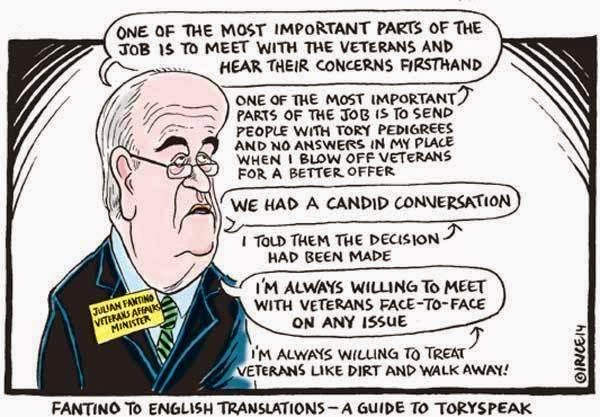
If you spoke to Julian Fantino (Minister of Veteran’s Affairs) or Rob Nicholson (Defence Minister), they would assure us all that our vets are being taken care of and that no one in the military is being forced out before they are ready.

Except that is not what our vets are telling us in either word or deed. 

Too many vets have taken their own lives because they have no idea how they are going to care for their family without their military family’s help – their country’s help.

Mental health services have been decimated across this country at every level from Child and Youth Mental Health services, to services for severely mentally ill people on the streets, to our vets.  Federal and provincial governments have failed to provide citizens with the care they desperately need.

The fact that Stephen Harper and his cronies can puff up their chest and declare the death sentences of hundreds of more soldiers, in yet another fight that is not ours, and then cut off the support they need when/if they come home is appalling and shameful.  This government is all about selling out and cashing in.


We have all heard of the treatment this government has given vets and yet nothing changes. 

Stephen Harper loves to make vets but hates to take care of them when they return from his phony wars.  SHAME!

Julian Fantino fattens himself off of a post which steals money from men and women (and their families) who so desperately need it.  He turned his back on vets, stood them up, and refused to apologize when he was called out on his abhorrent, disrespectful behaviour.  SHAME!


Rob Nicholson attaches himself to international conflicts and coalitions which have nothing  to do with Canada, sacrificing yet more Canadian citizens, only to deny their need upon their homecoming…making many of them homeless.  SHAME!

Government capitalises upon the jingoism of past wars, WWI and WWII, for example and uses Armistice Day as a photo op to support its current, hawkish designs. 

The same key words are employed now to stir the people to arms as were one hundred years ago:  militarism, freedom, justice, way of life, terrorism (Gavrilo Princip was called a terrorist by the Austrians and Germans in 1914). 

The same old sentiment is employed to drum up support for sending yet more troops into yet another battle with which we have no connection.

The same people blindly support those old sentiments, stating that “our way of life is in danger.”

Bullshit. 

I side firmly with Gwynne Dyer and his idea, as discussed in his newest book:   Canada in the Great Power Game: 1914-1918, that Canada has been hoodwinked into war after war by Empire after Empire, causing us to sacrifice our citizens needlessly.

I agree.  We all too quickly have a knee-jerk reaction to things (shootings in Ottawa, vehicular homicide in Quebec) and attach meanings to them which have been foisted upon us by the Empire du jour. 

We swing on the teat of those Empires and, because of our imaginary indebtedness, blindly, willingly cast off hundreds of thousands of lives.

We must stop this. 

Somehow we must stop this.

We must stop the grotesque use of the iconography and rituals of Remembrance as a form of jingoism – especially as used by those who would pile high the corpses of those they have sacrificed.  This is a time to honour the dead, not to feed the war machine.


We must provide help for all those who need it – military service people or otherwise – particularly for mental health issues.

We must, by any means necessary, hold our governments to accompt when it comes to the care of those who have served.  We may not agree with the wars in which they served but we, as a society, owe support to those who chose to serve in them.  

The government put them there.  The government owes them some modicum of respect for placing them in harm's way.

Nearly one year ago, several vets illustrated that point.


Saturday, 8 November 2014

As per request: My Annual Remembrance Day Speech

If I could put my ear to the rippling shadows and hear the whispers of the “…millions of mouthless dead…” who died “…pro patria…”  in that far away time.

In those far away places –

What would they tell me?
What would they tell me to tell you?


They would want you to know that the Earth is cold
And Death is lonely –
Even though there are so very many of them,
The “…mouthless dead…”
And it never seems to stop –
Even though their war.
The Great War,
Was supposed to be the war to end all wars.

They would tell me:
The Earth is cold
And Death is lonely.


They chased Honour
And Glory
Like Rainbows
And Wishes
And when they grabbed at any of them,
Came up empty handed.

They would tell me to tell you why we do this now:  this act of collective, ritual grieving.

Grieving for the old dead -
The Dead who lie in foreign fields.

We do this because those deaths matter.  They had wives, mothers, sisters, fathers, brothers, sons, and daughters.

This point is brought home to me everyday when I see my 22 year old son, my husband, and my 19 year old daughter.  One hundred years ago, they all would have enlisted – my husband and son as soldiers and my daughter as a Nursing Sister.

This point is brought home to me when I look into the face of my 12 year old son who, 100 years ago, would have watched his family march off to war only to join them in a few years.  He, like many boys his age, would lie to join his family overseas.

I often think of all of those things these days and the point of all of this ritual is brought, quickly, home to me. 
In 1917 or 1918, a German couple travelled, by train, from the small town near their farm to the city nearby.  They were not rich people so they were not able to afford a cabin of their own.  Soon it was clear to all those who sat near them that the journey would have been more comfortable for all concerned if the farm couple could, indeed, afford a cabin of their own. 

You see, the woman kept counting: 1-2-3-4-5, 1-2-3-4-5, 1-2-3-4-5.  She would pause for a moment and start again:  1-2-3-4-5.  The counting continued hour after hour.  Finally someone nearby snapped at the husband:

“Can you not quiet your woman?  Her counting makes the rest of us uneasy.”

The husband turned to the angry passenger and quietly said:  “I beg your pardon, sir. My wife has quite lost her wits.  You see, hour counting 1-2-3-4-5, is the counting of our dead sons.  All five.  All dead.  The last one died in France last week. 

I am taking her to an asylum in the city, for all she does now is weep and count her dead sons.  There is nothing I can do to comfort her.  Nothing I can do to stop her weeping; her counting.”

So many dead mothers.
So many dead sons.

One such mother’s son was Charles Hamilton Sorley; a 19 year old British Officer.  Sorley had no interest in fighting the Germans in the Great War.  He had just returned to England from studying in Germany.

Charles got home.
He enlisted.
And he fought and died on the Western Front.

He died on the Western Front – 19 years old –
A poet who did not want to fight or kill someone who may have been his friend from the university in Germany in which he studied.

A poet sceptical of those who tried to sell the war under the guises of “glory” and “honour.”

A poet who wrote about the “…millions of mouthless dead…” as a way of dealing with his anguish, anger, and angst.

When You See Millions of the Mouthless Dead'


When you see millions of the mouthless dead
Across your dreams in pale battalions go,
Say not soft things as other men have said,
That you'll remember. For you need not so.
Give them not praise. For, deaf, how should they know
It is not curses heaped on each gashed head?
Nor tears. Their blind eyes see not your tears flow.
Nor honour. It is easy to be dead.
Say only this, “They are dead.” Then add thereto,
“Yet many a better one has died before.”
Then, scanning all the o'ercrowded mass, should you
Perceive one face that you loved heretofore,
It is a spook. None wears the face you knew.
Great death has made all his for evermore.

How freely we gave our sons.
How freely they died.


If, 100 years ago, my son or husband were among the “…millions of mouthless dead…” I would listen carefully –
So carefully –
To the rippling shadows –
Waiting to hear their voices
And to tell you to simply
Remember.


*********************************************************************************

The above was my speech at the annual Remembrance Day assembly.

Here is the video/slide presentation I put together:


Thank you for taking the time to read and view this post.  
It means a lot.